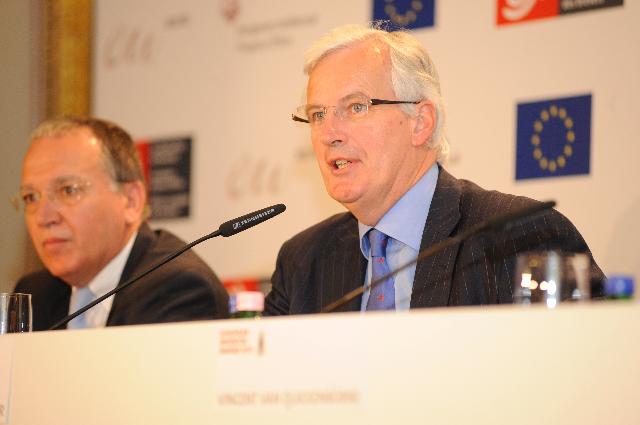
Benoît Battistelli and Michael Barnier at the 2011 European Inventor Award ceremony
Yesterday the EPO News channel reported on a “renewed commitment to cost-efficient European patents” by the EPO and the European Commission. As nobody really had the slightest doubts on the continued and strong support by the project’s two main driving forces, this “news” does not sound that confident and persuasive as it apparenty was intended.
I cannot help, but to me it sounds more like political PR language or even autosuggestion if the President of the EPO, Benoît Battistelli, and the European Commissioner for the Internal Market and Services, Michel Barnier, jointly confess that “the unitary patent is [...] expected to simplify procedures and lower the costs for applicants by up to 70%“.
No doubt, that sounds like excellent news for European patent applicants. However, what is actually intended is that
The unitary patent will be granted by the EPO under the same procedure, criteria and rules for examining patentability as the existing European patent, all of which are laid out in the European Patent Convention (EPC). Its advantage will lie in the post-grant phase, when the patent will be given unitary protection effect throughout the territory of the EU member states participating in the unitary patent scheme.
In other words, it is not any more desired that patent APPLICANTS profit from the promised cost savings but rather patent PROPRIETORS who decide to enforce their granted patent – i.e. a vanishing minority of all patentees. This has been made clear by Mr Battistelli earlier this year, when he openly confessed in an interview that:
- We need to help SMEs use the EPO and we must reduce the cost of doing so”;
- [I do] “not believe there should be any changes in the overall level of EPO fees“;
- “If any increases were needed, [...] they should come from renewals and not from applications”.
Wow! So, despite the conclusion of Unitary Patent advocates that “the current system for obtaining patents throughout the EU is too expensive“, this truly self-confident statement of the EPO’s political president clarifies that the promised cost savings will not hit patent applicants at all. So it appears that Mr Battistelli’s claims that “we must help SMEs” and “we must reduce costs” actually means that someone else should help SMEs and someone else should reduce costs.
It has been continuously argued that the unitary EU Patent would be significantly cheaper than the existing EP Patent (as currently granted by the EPO) since translation costs would drop dramatically:
[...] for a granted patent to be effective in a [EPO] Member State, the inventor has to request validation in each country where patent protection is sought. This process involves considerable translation and administrative costs, reaching approximately €32.000 when patent protection is sought in the EU27, of which €23.000 arises from translation fees alone. In comparison, a US patent costs €1.850 on average. [EU Commission, press release of 13 April 2011]
Even if that might be the case, the calculation is not that candid since the sketched scenario is unrealistic as only an extremely limited number of applicants really desires and thus would validate a patent in each single EU member state. Applicants are not so much interested in theoretical cost savings that only occur in comparison to a hypothetical patent validated in the EU27 or EU25. Rather, applicants want to know how much cheaper patent prosecution will be in comparison to their today’s costs. And these figures almost entirely depend on the translation fees that applicants effectively spend today.
Considering that the London Agreement has already abolished translation requirements for most of the more important EPC/EU economies, such as UK, FR, DE, NL, SE, DK – but not, however, for IT and ES – the cost savings from unneeded translations will be very limited, especially since the two most important countries that did not enter the London Agreement, namely Italy and Spain, do not participate in the Unitary Patent either.
The only significant cost reduction of EU patent prosecution as compared to the present situation can be expected from decreased renewal fees. This difference, thought, might not be overwhelming and by far not 70% since the EPO’s renewal fees already are significantly higher than national renewal fees – besides this, the EPO president appears to even consider increasing renewal fees ‘if needed”. All together, European SMEs might be rather surprised ewhen they realise that the political promises did not come true – or only to very little extent.
(Photo : © EU, 2011)

Volker 'Falk' Metzler
European Patent Attorney, German 'Patentanwalt', European Trademark and Design Attorney, Computer Scientist, PhD, IP Blogger, Father of Two, Mountain Enthusiast
If you enjoyed this article, please consider sharing it!


MISCELLANEOUS


The KSNH blogging landscape


This blog and the German-language sister blog k/s/n/h::jur link to the two popular and privately run blogs IPJur und VisaePatentes and continue their work and mission with a widened scope and under the aegis of our IP law firm.
ksnh::law Syndication
Why not subscribing ksnh::law via e-mail? Simply enter your e-mail address and click OK.  KSNH::JUR Feed (german)
- Ist Verschlüsselung passé? September 6, 2013Auf verschiedenen Feldern beruflicher Praxis ist dafür zu sorgen, dass Kommunikation vertraulich bleibt. Die trifft beispielsweise für Ärzte zu, aber auch für Anwälte, darunter auch Patentanwälte. Einer der zahlreichen Aspekte, die in diesem Zusammenhang eine Rolle spielen, ist die Technik, um die Vertraulichkeit beruflicher Kommunikation sicherzustellen. Wa […]
- EU-Einheitspatent: Demonstrativer Optimismus und Zahlenmystik allerorten – Naivität oder politische Beeinflussung? June 26, 2013Nach mehreren vergeblichen Anläufen zur Schaffung eines EU-weiten Patentsystems wurde 1973 als Kompromiss das Europäische Patentübereinkommen unterzeichnet, welches unabhängig von der seinerzeit noch EWG genannten Europäischen Union System zur zentralisierten Patenterteilung mit nachgeordnetem Einspruchsverfahren durch das Europäische Patentamt schuf. Wie wi […]
- Moderne Zeiten oder: DPMA und Patentgericht streiten über die elektronische Akte April 25, 2013Bekanntlich hat das Deutsche Patent- und Markenamt (DPMA) im Jahre 2013 mit der rein technischen Fertigstellung der Einrichtungen zur elektronischen Akteneinsicht einen wichtigen Meilenstein seines Überganges von der Papierakte zur “elektronischen Akte” erreicht. Im DPMA werden aber bereits seit dem 01. Juni 2011 Patente, Gebrauchsmuster, Topografien und erg […]
- Gutachten zu Forschung, Innovation und technologischer Leistungsfähigkeit Deutschlands 2013 March 11, 2013Unter dem Datum vom 28. Februar 2013 ist die Bundestags-Drucksache 17/12611 veröffentlicht worden Sie trägt den Titel Unterrichtung durch die Bundesregierung - Gutachten zu Forschung, Innovation und technologischer Leistungsfähigkeit Deutschlands 2013. Die Bundesregierung legt dem Deutschen Bundestag seit dem Jahr 2008 […]
- 3D-Printing: Zum Filesharing von 3D-Modelldaten February 25, 2013In meiner kleinen zuvor angekündigten Reihe über rechtliche Aspekte des 3D Printing komme ich heute auf die Frage zu sprechen, ob die Hersteller von Gerätschaften es hinnehmen müssen, wenn Ersatztreile davon – vom Brillengestell über Smartphone-Gehäuseteile bis hin zu Rastenmähermotor-Abdeckungen – gescannt und die daraus […]
- Ist Verschlüsselung passé? September 6, 2013